Origin of sewage
sewage is generated by residential, institutional, commercial and then storm water runoff or urban runoff events.
Sewage treatment, which may also be referred to as waster water treatment, is collectively, the processes to remove contaminants and reduce their concentration from waste water, which fits either (e.g., underground water, river, lake and creek treatment) for drinking purposes or for be safely returning used water (residential, institutional, commercial) to the aquatic environment.
sewage is generated by residential, institutional, commercial and then storm water runoff or urban runoff events.
Sewage treatment, which may also be referred to as waster water treatment, is collectively, the processes to remove contaminants and reduce their concentration from waste water, which fits either (e.g., underground water, river, lake and creek treatment) for drinking purposes or for be safely returning used water (residential, institutional, commercial) to the aquatic environment.
Substances that need to be removed include:
1. Volatile materials, causing air pollution
2. Color and turbidity, causing aesthetic problem
and toxicities3. Suspended solids, deposition of solid impairs aquatic life
4. Soluble organic matter, causing depletion of dissolved oxygen
5. Organic pollutants, causing tastes, odors and toxicities
6. Metals (mercury Hg, cadmium, Cd, lead Pb, chromium Cr, arsenic As) and cyanide,
causing toxicity
7. Nitrogen, N and phosphorus P, causing eutrophication
8. Refractory substances resistant to biodegradation, toxic to aquatic life
9. Oil and floating materials
The processes of sewage treatment, in general, involves physical, chemical and biological processes:
Physical treatment - membrane technologies, carbon adsorption, distillation, filtration, ion exchange, oil and grease skimming, oil/water separation, sedimentation, steam stripping, and solvent extraction;
Chemical treatment - chemical oxidation, chemical precipitation, chromium reduction, coagulation, cyanide destruction, dissolved air flotation, electrochemical oxidation, flocculation, hydrolysis and neutralization (pH control);
Biological
treatment - using microorganisms to remove carbonaceous, Nitrogen N and sulphide
S under either aerobic (either via oxidation or endogenous respiration)
or anaerobic conditions via the following three applications:
1. Pond treatment
2. Activated
sludge process
3. Biofilm
process.
There are several process steps in a typical sewage treatment plant, as shown in the diagram given in Sewage treatment,
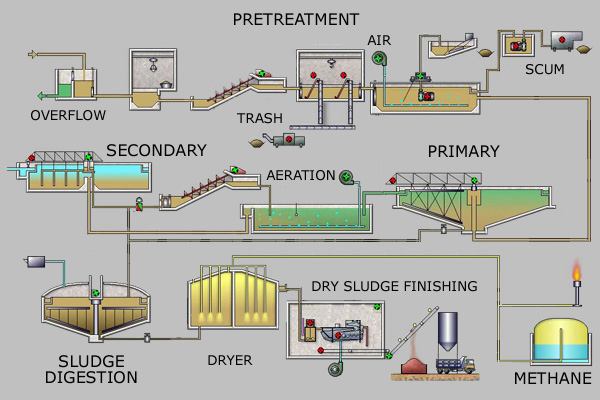

1. Pre-treatment removes, by bar screening, all materials that can be easily collected from the raw sewage, including trash, tree leaves/branches, and other large objects like cans, rags, plastic packets. Pre-treatment may include a sand or grit channel or chamber, where the velocity of the incoming sewage is adjusted to allow the settlement of sand, grit, stones and broken glass.
2. Primary treatment consists of temporarily holding the sewage in a quiescent basin where heavy solids can settle to the bottom while oil, grease and lighter solids float to the surface. The settled and floating materials are removed and the remaining liquid may be discharged or subjected to secondary treatment. Some sewage treatment plants that are connected to a combined sewer system have a bypass arrangement after the primary treatment unit. This means that during very heavy rainfall events, the secondary and tertiary treatment systems can be bypassed to protect them from hydraulic overloading, and the mixture of sewage and stormwater only receives primary treatment.
3. Secondary treatment removes dissolved and suspended biological matter, typically performed by indigenous, water-borne micro-organisms in a managed habitat. Secondary treatment may require a separation process to remove the micro-organisms from the treated water prior to discharge or tertiary treatment.
4. Tertiary treatment is sometimes defined as anything more than primary and secondary treatment in order to allow rejection into a highly sensitive or fragile ecosystem (estuaries, low-flow rivers, coral reefs,.). Treated water is sometimes disinfected chemically or physically (for example, by lagoons and microfiltration) prior to discharge into a stream, river, bay, lagoon or wetland, or it can be used for the irrigation of a golf course, green way or park. If it is sufficiently clean, it can also be used for groundwater recharge or agricultural purposes.

No comments:
Post a Comment